
Human trafficking remains a part of our daily lives, and in its most horrid form. It is prevalent as an industry that exploits individuals and organizations in multiple ways: through sex, labor, or other types of forced servitude.
Let’s start off by asking, what makes you uncomfortable about this topic? What are some things your worry about? Some will say knowing the fact that it could be anyone at anytime involved and that you could possibly be a target. Others say that as a single person out and about, having to be vigilant and aware of your surroundings. Needing to share your location with your family and close friends at all times so someone is aware of your whereabouts “just in case”. The worry list goes on…
During tonight’s event, we talked about what human trafficking is, how you can talk with your children about it and how you can help.
What is human trafficking? According to the department of homeland security “Human trafficking involves the use of force, fraud, or coercion to obtain some type of labor or commercial sex act.” Human trafficking can occur anywhere. In 2020, Global Report, it was discovered that “in 2018, about 50,000 human trafficking victims were detected and reported by 148 countries” (unodc.org). In 2020, the proportion of victims recruited by a family or caregiver increased significantly from 21% to 31%. It is also stated that one in five victims of human trafficking were believed to be children, exploited for child labor, child pornography and begging.
The top 4 things that traffickers look for are:
- Psychological or emotional vulnerability
- Poverty
- Gender Inequality
- Addictions
Common places or ways one might get abducted are outdoor locations, heavily crowded areas and through the use of technology. A few ways to identify human trafficking are when multiple people are in a small or tight space, the inability to speak to an individual alone, signs of physical and more.
One of the top tips that we shared with participants were how and when to talk to your kids about human trafficking. Here are some tips that were shared:
- Create a safe space open to communication
- Ask a mixture of open and closed ended questions
- Monitor their use of technology
- Have the conversation as early as nine up to 16+ years of age
Some ways that you can help is by creating safety plans, asking questions if you suspect human trafficking and research your area and become informed. We have a list of great resources that you can use to get more details on human trafficking and more.
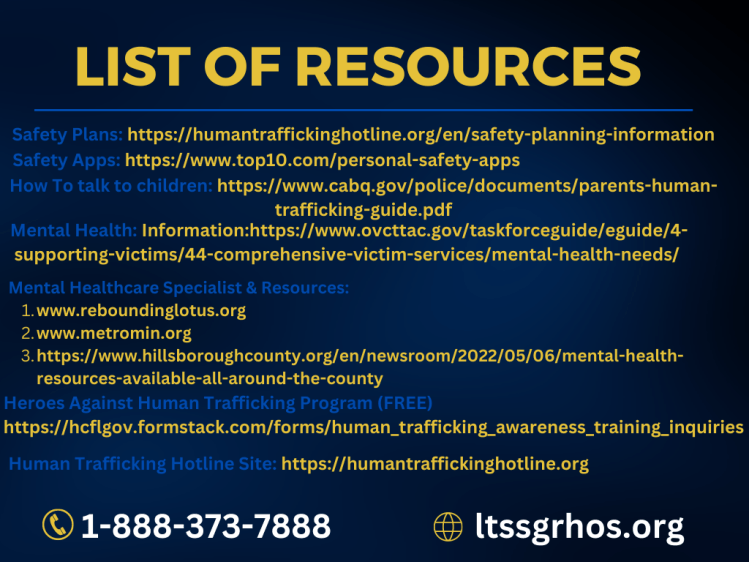
To access the clickable links, view the slides here and go to slide 22: Let’s Talk About It: Human Trafficking 101 Slides
We hope that you never need to use this information because no one you ever meets is involved in human trafficking. However, it can be a good idea to take the time to learn about this phenomenon and what you can do to help prevent it from occurring. Knowledge can help combat human trafficking, and if anyone does approach you about anything illegitimate, we advise that you report your suspicions to the authorities or organizations that you have learned about during your research. And if there’s a certain topic about human trafficking that you’re interested in learning more about, tell us; we’d like to hear from our readers.
Until next time…
 Lambda Theta Sigma Alumnae Chapter | Sigma Gamma Rho Sorority, Inc.